The Sleep Captain
The Sleep Captain by JT Thomas * Illustrations by Shane O'shaughnessy
The Sleep Captain by JT Thomas * Illustrations by Shane O'shaughnessy
Emma felt high in the way that you do when you are finally given the job you secretly felt you always deserved. Crew members on the ship lived increasingly long lifespans, and thus it was rare for third gens or fourth gens like her to be assigned positions of any real importance. Automation and a surfeit of personnel meant that there was actually very little work to be done on the ship as it drifted listlessly through a barren part of space, a place devoid of anything besides neutrinos, dust, and hydrogen and helium plasma, the fourth state of matter.
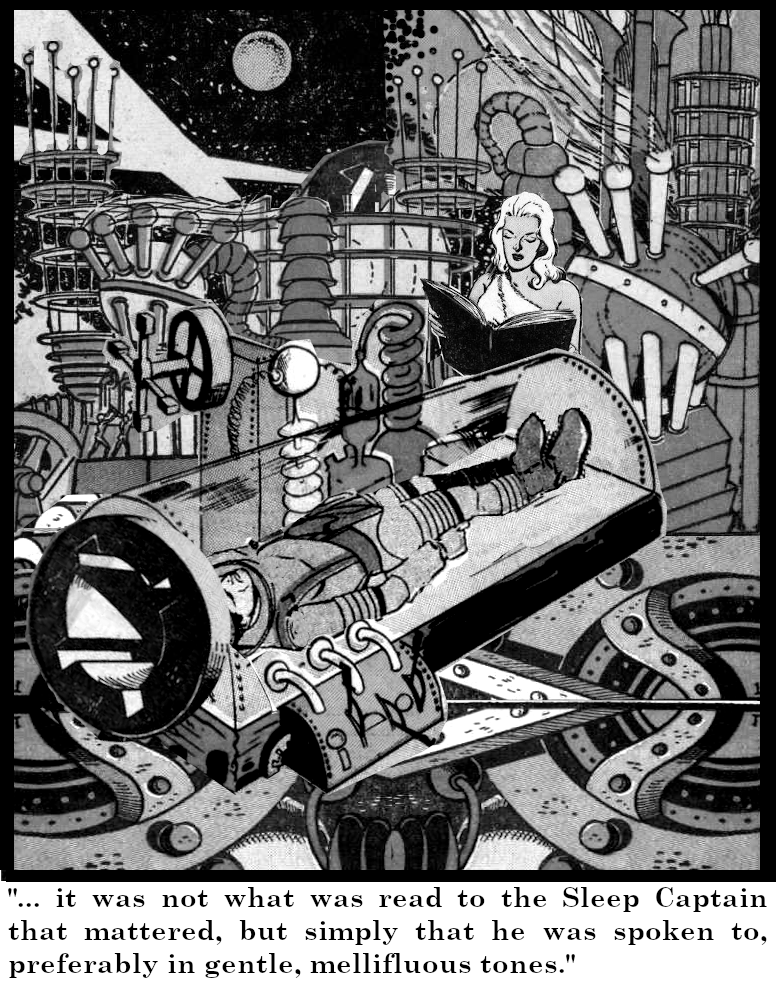
Monitoring the slumbering captain of the ship was an important, perhaps the most important, position in the crew. She thought about her old job as she checked the Sleep Captain’s vitals and straightened the bright white linens on his bed. Emma had previously been assigned to the analysis of virtual particles that popped in and out existence in the deep fabric of space, particles whose entangled partners were typically too far away to verify spin — busy work.
Emma rolled the Sleep Captain over in his bed and changed his soft, gauzy gown, massaging his legs, arms, and torso to encourage circulation and prevent bedsores. Of course this could be done by the bed itself, or by the nanomachines coursing through his veins like invisible sponges, but the second gens insisted on the palliative effects of actual human touch. While this practice (at best) did not seem to be evidence-based, and (at worst) seemed quasi-mystical in nature, Emma was happy to do it. Her dominant emotion growing up on the ship had been boredom.
She looked down at the Sleep Captain’s face, which was smooth and unlined, tranquil. He was a beautiful man, although it was difficult to put your finger on the exact set of features that created the effect. Emma smiled at him and gently blew a few stray hairs off of his forehead. His chest moved slightly up and down, almost imperceptibly so. Other than this, the Sleep Captain never stirred, never made a sound, and from what she had been told, had not in over a century. A nearly complete vegetative state.
She sat in a chair next to him in the cabin. The only sound was an occasional clicking from the electromagnetic barriers that protected the room from any type of radiation that might shorten the Sleep Captain’s telomeres and precipitate the onset of aging pathogenesis. Accessing her connected memory, Emma began to read to him from Madam Bovary, a text that was thousands of years old, and from which she had chosen her name. Its language was anachronistic and hard to follow, and the culture of its characters odd and often inappropriate, but there was something to the circularity of the story that she enjoyed. Emma had been told that it was not what was read to the Sleep Captain that mattered, but simply that he was spoken to, preferably in gentle, mellifluous tones. After she grew hoarse, they sat in silence. Emma felt as though they could be two old friends who did not need to fill the air with words, but could simply enjoy one another’s presence. As her shift came to an end, she stood up and bent over him, singing quietly into his ear, “It’s snowing all the time at the south pole of Enceladus/Oh won’t you join us, see it again?”
****************************************************************
The ship had left the moons of Saturn three hundred years earlier, staffed by the first gens and led by the Sleep Captain, who at that time had been both very awake and extremely popular. Earth at that time was nearly uninhabited, with the exception of a few million people living miles under the surface of the crust or in non-acidified patches of ocean floor. A few sub-stations existed in the lithosphere, but the scorching temperatures made all but brief excursions impossible. Anthropogenic climate change had long since been dwarfed by the impact of 87/Borisov, which, with the force of over a billion atomic weapons, created a 20 kilometer crater in one northern continent and distributed enough particulate matter into the atmosphere to effectively halt photosynthesis, resulting in the extinction of 90% of terrestrial plants and animals. The oceans, however, bloomed with algae and other simple life forms.
Although all first gen members of the crew were informed before departure that theirs was a one-way rather than a round-trip ticket, only the Sleep Captain — known then simply as the Captain — knew the purpose of the mission and its final destination. The ship had no propulsion system as such, but rather created a pocket of antigravity in front of it into which the ship “fell” forward at roughly 48% the speed of light. The acceleration and decelation of the ship took many decades (quantum inertia dampeners notwithstanding, large shifts in velocity on this order were very tricky for biological organisms). Even at half light speed, it was made clear to the crew that it would be hundreds of years before the ship reached its final destination and that several generations of crew members would be born and die before arrival.
As with all groups of humans, speculation and gossip about the reason for the mission ran rampant, but there was not a person on board who did not fully believe in the talents and capabilities of the Sleep Captain. Whatever the reason behind the journey (A new planet? Following a distant beacon from other conscious beings?), each crew member implicitly trusted him. Most first gens were unaware of the genetic and psychological tinkering that went into their own disposition towards the Sleep Captain, namely the attitude that he was (1) a genius in regard to astrophysics, and (2) genuinely one of the nicest, most empathetic people they had ever met. Second and subsequent generations understood this manipulation of attitude, but in deference to ship culture, never pushed the issue publicly.
Every possible protection was put into place to protect the longevity of the ship’s steward, the only person on board aware of the coordinates and purpose of the flight. The Sleep Captain never left a small region of the ship that was — at a great and inordinate cost in terms of energy — protected from any type of radiation, particularly high-energy electromagnetic waves. Even at the quantum level, much was done to subdue virtual particle fluctuations, although all potential effects could not be mitigated. The Sleep Captain underwent continual genetic-enhancement to protect DNA replication, RNA transcription, and telomerase elasticity. In order to enhance his longevity, he was compelled by his physicians to exercise for over six hours per day, and fed a diet of organic fruits, vegetables, and proteins, the only food on the ship that was not artificially replicated but actually grown. Yet his overall caloric intake was severely restricted. The Sleep Captain was given matcha made by a master tea brewer who could trace her ancestral roots all the way back to Japan. Extreme precautions were taken to prevent him from coming into contact with crew members who might be ill, or exposure to any other type of biological, psychological, or radioactive contamination. The Sleep Captain was encouraged to have sex as much as possible, although after some period of time, his appetite for this health-enhancing pleasure diminished, much to the chagrin of his medical staff. Other than monitoring the path of the ship, the bulk of his time was devoted to meditation.
*****************************************************************
It was directly after the birth of the third gens that crew members began to notice that the behavior of the Sleep Captain had started to change. Until this point, he had remained positive about the mission and extremely affable, open to speaking with the staff at any point. No one could pinpoint the exact start of this abnormality, but it seemed to begin sometime after the breakdown of a long-term sexual and romantic relationship between the Sleep Captain and a favored second gen. Word among the crew was that the Sleep Captain’s lover had spurned his affection and chosen a new partner — something that hadn’t occurred in the past. This uncharacteristic rejection seemed to have a profound impact on his psyche, which was odd for a leader who had been universally deemed unflappable in the face of any type of problem.
The Sleep Captain began to exhibit signs of a serious mental breakdown at an accelerating pace. It began with an obsession with memorizing Pi to an increasing numbers of digits; although he could at any point access millions of digits of Pi using his connected memory, the Sleep Captain began to start every day by using his biological memory to recall more and more digits of Pi and writing them down — by hand — on small scraps of paper. Each day the Sleep Captain would expand the number of digits he was able to memorize by a few numbers, and refused to speak with his attendants and physicians until he had done so. This graphomania began to take up larger and larger parts of the day, baffling the crew, who at first assumed it was part of some larger scheme that they were incapable of understanding. Sometimes during the evening, he would call the most important members of his staff to his quarters, where he would recite tens of thousands of digits of Pi from rote. This went on for several decades, and when questioned by his doctors, the Sleep Captain would only reply that he was seeking the last digit of Pi, which, as a non-terminating, non-repeating decimal, was utterly irrational.
The Sleep Captain began to exhibit other psychological maladies as well. In particular, he seemed to suffer from the Cotard Delusion, in which the subject is convinced that they are, in fact, dead. While numerous lines of evidence were laid out for him to prove otherwise, nothing could be done to dissuade him from the reality that his consciousness and biological functioning were quite intact. In response, he would say, “This is all a dream that happens in the moment of death,” in a way that was impossible to tell if he was trying to make a joke or expressing something further.
Then the most serious signs of what was to become a permanent type of narcolepsy began to show. It started very simply, with the amount of time he slept. In the past, his regime had been a strict eight hours of sleep, with perhaps a single minute of variation in somnolence and wakefulness. But the Sleep Captain started to sleep ten, then fifteen, and soon twenty hours a day. During briefings about the path of the ship, he often drifted in and out sleep, despite his crucial position in its progress.
Eventually the Sleep Captain fell into a deep, dreamless slumber, occasionally exhibiting unconscious motor function in his muscles, which eventually subsided into basic autonomic nervous functions. His blood pressure and breathing remained entirely normal, but brain function appeared to decline to the bare minimum. Eventually his pupils stopped reacting to light entirely, and other signs of intact reticular formation stopped. At his most somnolent, only a minimum of culocephalic and oculovestibular reflexes were demonstrable in tests.
*****************************************************************
The crew began to worry. Was this part of the plan? Perhaps an unknown type of life-extending process designed to extend the longevity of the Sleep Captain and put in place before the ship had departed? How would they know where they were going and when they had gotten there?
For decade after decade, during the time of the third gens and the birth of the fourth, the ship drifted aimlessly through hundreds of thousands of parsecs of space. No one in the crew understood what was happening, or why it was happening, or when the Sleep Captain would awake and shepherd them to the final destination. While the uncertainty and mystery surrounding the journey had been acceptable to the crew in the past, without his reassuring guidance, dissent began to foment. The ship was completely self-sustaining, but at what point do you panic? Was it even possible to turn back? While many assumed that the distortion effects upon time within the ship itself should be minimal, most second gens understood that it was human psychology, rather than velocity, that actually made time slow down. A sense of purpose, of knowing where you are going, makes time behave one way, but waiting for an event slows time to a crawl.
*****************************************************************
For over a century, the Sleep Captain remained in total stasis. Despite biomedical enhancements in longevity, eventually the last of the first gens died. Medical advancements seemed to have minimal effect on the state of the Sleep Captain, but miraculously he did not seem to age, and his cells stayed firm and young. At some point, a bizarre plan emerged among a subset of the dwindling second gens that they must try to communicate with the Sleep Captain, regardless of his responsiveness. This is how the choruses began.
Crew members, who organized themselves in daily shifts, began to speak and sing and read to the Sleep Captain in chorus. For approximately eight years, there was no evidence that this had any effect whatsoever: autonomic nervous system signs remained strong, but no additional activity in brainwave function could be detected. Eventually, however, although he did not wake up, it became clear from the signs of deep NREM sleep and the simple observation of new facial tics and muscle spasms that the Sleep Captain was dreaming. Sleep cycles began to resemble the circadian rhythms of normal humans. More complex brain stem reflexes, including yawning, chewing, swallowing, and guttural vocalizations became more common. Arousal and startle reflexes like blinking and even eye opening were rumored. Members of the choruses touched his hands, hoping to entangle their particles with his particles in order to provoke him, and engaged in other types of unproven magical thinking.
Within a few more months, the Sleep Captain began to intermittently mumble incoherent phrases. The crew wondered if these signs meant he was about to wake up, but after generations of being lost in the recesses of space, no one wanted to get their hopes up. The potential signs of the awakening of the Sleep Captain seemed to plateau at this point, however. This caused a minor panic among some of the third and fourth gen crew members, who had to be placated with words of encouragement from the remaining second gens: “Things can always be worse.” No one in the crew dared to mention the possibility that the Sleep Captain might awaken lacking the knowledge or capacity to steer the ship towards its final destination.
*****************************************************************
The following day, Emma was again assigned to monitor the Sleep Captain. She combed his hair and straightened the crisp sheets of the bed, and read out loud from Madam Bovary, although a bit bored this time. His arms and legs occasionally twitched as if he were restless. Emma thought that it didn’t matter where the ship was going; she had arrived on time at exactly the right place. She put an index finger in his palm, and the Sleep Captain grasped it with the deep evolutionary reflex of a primate. As he groaned and rolled over onto his side, an unprecedented sign of reanimation, Emma tightly covered his nose and mouth with her other hand.
